
Forsyth Projected and Actual Release
A projected release date is a calculation for a current sentence episode. NCDAC may adjust it as sentence data, jail credit, earned time, discipline, added judgments, or other legal events change. An actual release date records an event that has occurred. Even then, the disposition must show whether the person entered the community, moved to supervision, returned to a sheriff, or transferred elsewhere.
A pretrial resident at the Forsyth County Law Enforcement Detention Center generally has no computed sentence end. The person may leave on bond, unsecured release, dismissal, or court order, remain because of a hold, or later receive a sentence. A court order can authorize release before physical discharge is processed. FCSO's final-release record supplies the jail exit or transfer detail.
Scheduled is not actual. A future projection estimates one sentence path. Confirm the completed event with NCDAC or FCSO and check for receiving custody.
Find a Forsyth Release Date
The correct channel depends on who holds the person. Forsyth Correctional Center is a state prison, so its sentenced residents appear in NCDAC systems. FCLEDC is a county jail, and ordinary bond releases do not appear in the state prison database. The adult searches also are not substitutes for confidential juvenile channels at Forsyth County Youth Services Center.
- Identify the custodian: FCLEDC, NCDAC, another jail, federal custody, or a confidential juvenile system.
- For a state prisoner, open the NCDAC Offender Public Information search. Use the offender number when known, or match a name with age, birth details, conviction county, offense, and dates.
- Open the matching detail and read the exact “Projected Release Date” label. Check sentence and status fields before treating it as the current prison term.
- For completed state custody, look for the actual release date and status history. Community parole or PRS can remain active after prison release.
- For a sentenced county misdemeanant, call FCLEDC at 336-917-7600 and ask jail staff for the calculation based on the judgment, jail credit, and authorized credits.
- For a pretrial case, check the Forsyth court record and FCSO status instead of asking for a sentence projection that does not yet exist.
The Forsyth released-inmate search provides the broader path when the agency or type of release is not yet known.
Forsyth NCDAC Date Fields
NCDAC OPI is a statewide prison and community-supervision archive. A person released from Forsyth Correctional Center is searched the same way as someone from any other state facility. OPI is also the next stop after FCSO confirms a transfer to Corrections. Its official search hub excludes county-jail information.
| OPI field | Release-date use |
|---|---|
| Offender number | Best public key for matching the correct state record. |
| Status and location | Separates prison custody, community supervision, and inactive history. |
| Admission and sentence data | Connects the projection to the correct term and judgment. |
| Projected Release Date | Current calculated date; it can change and is not a confirmed exit. |
| Actual release date | Completed event for the displayed episode, read with its disposition. |
| Supervision history | Shows whether parole, probation, or PRS follows physical release. |
Include inactive records when checking a past event. “Active” does not always mean prison walls because it can describe probation, parole, or PRS. “Inactive” means no present NCDAC custody or supervision record, but it is broader than a recent release. Read the dated episode instead of relying on the status word alone.
The official Structured Sentencing statute displays the rule behind many state projections.
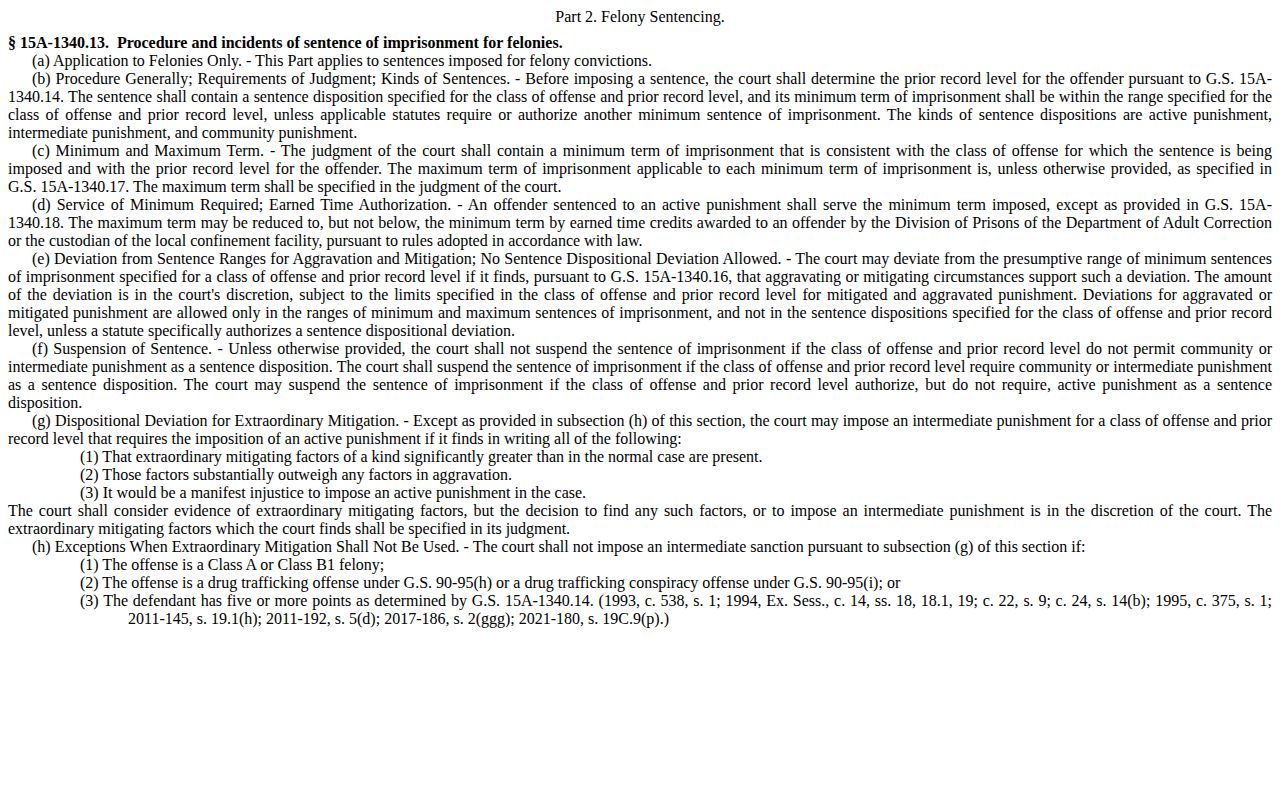
The statute limits how earned time affects a felony term, so a personal date should come from NCDAC's computed record rather than home arithmetic.
Forsyth Felony Release Computation
North Carolina Structured Sentencing felonies ordinarily require service of the imposed minimum. Under N.C.G.S. §15A-1340.13(d), earned time can reduce the maximum term but cannot move the prison term below the applicable minimum. NCDAC summarizes the framework as serving at least 100 percent of the minimum and about 85 percent of the maximum. The useful rule is the minimum-term floor, not a blanket instruction to multiply any sentence by 0.85.
For applicable felonies, Article 84A places the person on post-release supervision. The prison portion ordinarily ends at the maximum less twelve months for specified higher felony classes or less nine months for other covered classes, subject to the statute. Registerable offenses and special maximums can use longer rules. That community term remains correctional control even though the person has physically left prison.
Older Fair Sentencing and parole-eligible cases follow different laws and Commission decisions. Offense date, class, minimum and maximum terms, consecutive or concurrent structure, and credit history all matter. NCDAC sentence-record staff should supply an authoritative computation.
Note: Parole eligibility for an older case and a Structured Sentencing projected date are different questions controlled by different rules.
Forsyth Jail Credit Ceiling
County misdemeanants use a different framework. N.C.G.S. §15A-1340.20(d) caps earned-time credit at four days per month. Under N.C.G.S. §162-60, qualifying faithful work and specified program participation can earn four days per thirty days, subject to the ceiling and the custodian's determination. Escape or attempted escape forfeits that reduction.
The rule does not mean every FCLEDC resident gets four days. Jail staff must apply the judgment, qualifying confinement credit, authorized work or program credit, and any forfeiture to the individual record. Pretrial detainees have no sentence credit projection until a sentence exists. Ask for the calculation rather than assuming eligibility.
The official county-jail credit statute shows the qualifying work and program basis.
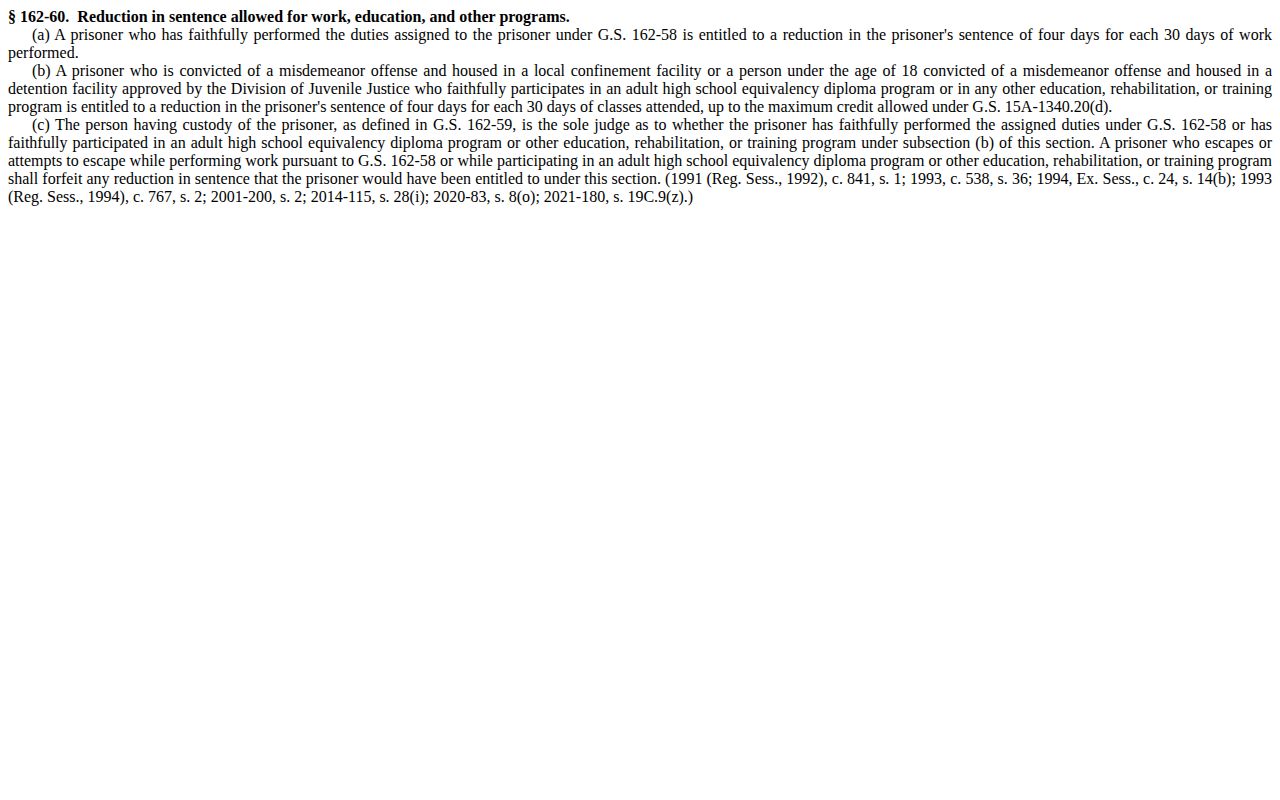
This local-jail rule should not be substituted for NCDAC's felony computation, and the state felony rule should not be used to predict an FCLEDC misdemeanor date.
Why Forsyth Release Dates Change
A sound projection reflects more than the sentence length printed on a judgment. It can move when the legal record changes or when an agency applies credits and holds. A move in the date does not by itself show an error.
| Factor | Possible effect |
|---|---|
| Jail credit | Qualifying pretrial confinement under §15-196.1 et seq. can be applied to the sentence. |
| Earned time | Authorized credit can reduce the calculated term within the statutory floor or ceiling. |
| Discipline | Credit may be forfeited or restored under the controlling rules. |
| Added or amended judgment | A new sentence, corrected judgment, or changed term can require recalculation. |
| Concurrent or consecutive terms | The relationship among sentences changes the overall end point. |
| Detainer or hold | One agency may end custody while another receives the person. |
| Parole decision | An eligible older sentence can depend on Commission action rather than modern PRS rules. |
A detainer is a request or legal basis for another agency to take custody. It can turn an expected community exit into a transfer. NCDAC policy also separates court-ordered release, return of a safekeeper to a sheriff, interstate compact release, pardon, commutation, and expiration or max-out. A safekeeper returned to FCSO is still in custody. An interstate compact case may place supervision in another state.
Expiration or max-out has a narrower policy meaning than everyday use of “release.” NCDAC defines it as complete service with no parole or PRS reporting for that sentence. A court-ordered release may instead end custody because of a new legal directive. Pardon and commutation have their own authority. Read the displayed release reason and the next status instead of turning all of these outcomes into the same event.
Forsyth Weekend Release Timing
No generally applicable current North Carolina statute was found that automatically moves every county-jail sentence end to Friday when it falls on a weekend or holiday. Do not promise an early weekday exit. FCLEDC must confirm the actual processing date and whether any court order, hold, or receiving agency affects release.
The legal end of one term and the practical time a person clears discharge processing can differ. For one named person, ask FCSO for the final-release timestamp and authority after the event. If the person transfers to NCDAC, another jail, federal custody, or immigration custody, the next agency must confirm the new status.
Confirm Forsyth Projected Release
Before an expected event, register with NC SAVAN or VINELink for a specific-person custody notice. The Forsyth VINELink inmate search explains the matched-record and phone-PIN steps. An alert is useful, but the source agency remains the authority for the exact date, time, release basis, and destination.
After a state-prison event, reopen OPI and compare projected date, actual release date, status, and supervision history. For county jail, use the FCSO contact route and request the final-release sheet if the answer must be durable. For legal authority, consult the Forsyth County court office or obtain the judgment or release order from the Clerk of Superior Court. The court record explains what authorized the event, while the jail record documents physical discharge or transfer.
Section 148-13 separately requires at least $45 upon discharge or parole for a person incarcerated two years or more. That limited assistance rule does not calculate the date and does not apply to every Forsyth release.
Correct Forsyth Release Calculations
A suspected state calculation error should be described field by field. Use NCDAC's public-records process and provide the offender name and number, date of birth, the Projected Release Date displayed, the sentence episode at issue, and any judgment that supports the request. Ask for the sentence or release history needed to explain the calculation. A local probation officer can confirm public reporting instructions for the supervised person but is not the public source for a prison computation.
For an FCLEDC misdemeanor calculation, identify the judgment, booking number, time already spent in qualifying confinement, and the work or program credit being questioned. Jail staff determine whether the statutory credit applies. Court staff can supply the authoritative judgment, while FCSO supplies the custody calculation and final-release record. Keeping those roles separate reduces the chance that a court disposition date will be mistaken for the physical exit time.
The dedicated NCDAC Inmate Release Search can filter recent state releases by county, year, and month or by surname. Forsyth is county code 34. On the research date, its year choices covered 2024 through 2026. A Forsyth “release county” result belongs to the state-prison dataset and must not be described as an FCLEDC release list. For older state events, use general OPI and include inactive records.